Everything you need to know about seeing a private shoulder specialist in London: insurance pre-authorisation, self-pay costs, GP referrals, and what to expect at your first appointment.


If your shoulder or elbow has been troubling you for weeks or months, waiting for an NHS appointment can feel like a long time when you're in pain. Private care moves faster, typically within one to two weeks , but if you haven't navigated the private system before, the process isn't always obvious. This page covers the practical steps: whether you need a GP letter, how your insurance works, what things cost if you're paying yourself, and what to expect when you come to see me.
No. If you're being seen privately, you can self-refer directly without going through your GP first. There's no gatekeeping and no waiting for a GP appointment before you can see a specialist.
That said, there are two situations where a GP letter is useful. First, if your insurer requires one as part of their pre-authorisation process, and some do while others don't, so check your policy. Second, if you've already had relevant investigations such as an X-ray or MRI, a GP letter helps transfer that information efficiently. Neither situation is a barrier to booking. You can contact the practice directly, and if your insurer needs a GP letter, that can usually be arranged quickly once you've decided to go ahead.
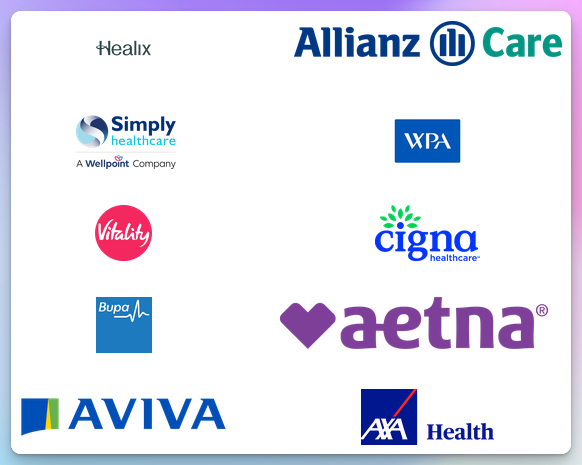
Bupa is one of the most common insurers I see patients through. Here's how the process works.
Call the number on the back of your Bupa membership card, or log in to your online account. Check that I'm recognised by Bupa, which you can confirm on their website or by calling, then request pre-authorisation for a consultation with a shoulder consultant. You'll be given a pre-authorisation number, which you quote when you book.
Bupa generally covers outpatient consultations, diagnostic imaging such as MRI and ultrasound, and surgical procedures when they're medically indicated. Pre-authorisation is almost always required before surgery and sometimes before certain scans. Get that authorisation before your appointment rather than after, as retrospective claims are harder to resolve.
The process is broadly similar across major insurers, with some variation.
AXA Health operates a pre-authorisation system. Call member services, confirm I'm recognised, and get a reference number before booking.
Cigna is commonly used for corporate and international policies. The pre-authorisation process is similar, though international policies sometimes have additional documentation requirements.
Vitality Health covers specialist consultations and surgical procedures but has its own approved consultant list. It's worth confirming recognition before booking.
WPA is a smaller insurer with a reputation for straightforward claims handling. Pre-authorisation applies here too.
For all insurers: keep records of your authorisation numbers and any written confirmation they send. If a question arises about a claim later, having that paperwork makes things considerably easier.
I am registered with most other private health insurers based in the UK. Most other insurers will cover a consultation with a recognised consultant even if I am not listed here. Call your insurer directly and ask: is Mr Toby Baring recognised, and would a consultation be covered under my policy? In most cases the answer is yes. The consultation is generally the easiest thing to get covered. Surgical procedures sometimes require more back-and-forth on authorisation, but a first appointment rarely does.
If you're paying yourself, you'll get a clear quote upfront with no surprises.
A first consultation with a shoulder specialist in London typically costs between £250 and £350. That covers the examination and a full discussion of your situation and options. If a scan is recommended, an MRI in London generally costs between £400 and £1,000 depending on the facility, and a diagnostic ultrasound is usually £250 to £750. I can usually direct you to the less expensive options without compromising on quality.
Surgical fees vary considerably depending on the procedure and hospital. Always ask for a fixed-price, all-inclusive package, this means the anaesthetist and hospital facility are both included, with no unexpected bills afterwards. Arthroscopic shoulder surgery in London ranges broadly from £4,000 to over £10,000 depending on complexity. Once I've assessed you and we've agreed on a plan, I can give you a specific quote.
Self-pay is sometimes faster than using insurance because there's no pre-authorisation process to navigate. Some patients prefer it for that reason.
A first consultation takes around 30 minutes. Here's what to bring and what to expect.
Bring any imaging you already have. If you have had an MRI or ultrasound please bring the report — for an MRI, let my secretarial team know where and when you have had it done and they should be able to retrieve it onto our system so I can view the images directly. Bring a list of medications you take. If you have a GP letter, ideally bring it, but it is not essential.
I'll ask you to describe your symptoms in your own words: when they started, what makes them better or worse, what you've already tried. I'll examine your shoulder with some specific movement and strength tests. If I need imaging I haven't already seen, I'll arrange it at the same appointment.
By the end of the visit, you'll have a clear picture of what I think is happening and what your options are. I don't give vague answers or ask you to come back before I've said anything useful. If the right answer is more physiotherapy, I'll say so and explain why. If it's surgery, I'll explain exactly what that involves and what the realistic outcome looks like. You won't leave with just a leaflet and no plan.
One Welbeck 1 Welbeck Street, London W1G 0AR
King Edward VII's Hospital Beaumont Street, London W1G 6AA
St John & St Elizabeth Hospital 60 Grove End Road, London NW8 9NH
Privately, appointments are typically available within one to two weeks. If your case is more urgent, for example significant weakness, a suspected acute injury including fracture, or severe pain affecting daily function — contact the practice directly and we'll do what we can to see you sooner.
No. You can self-refer and book directly. If your insurer requires a GP letter for pre-authorisation purposes, that's a separate step you can take once you've decided to go ahead. It shouldn't delay your appointment significantly.
Generally yes, when surgery is medically indicated and has been pre-authorised. Bupa covers a range of shoulder procedures including rotator cuff repair, frozen shoulder surgery, subacromial decompression, and shoulder stabilisation. The process is: get your diagnosis confirmed at a consultation, agree on a treatment plan, then get pre-authorisation from Bupa before any procedure is scheduled. Always get that authorisation in writing before committing to a surgical date.
Bring any imaging you already have, if you've had an MRI or ultrasound, please bring the report. For an MRI, let my secretarial team know where and when you had it done and they should be able to retrieve it onto our system. Bring a list of medications you take and your insurance details and pre-authorisation number if applicable. A clear sense of when symptoms started and what you've already tried is helpful, as is thinking about how the shoulder is affecting your daily life specifically, not just the pain level, because that shapes the treatment goals.
Yes. There's no restriction on receiving private care even if you've already started an NHS pathway. Many patients see me privately for a specialist consultation or surgery while continuing NHS physiotherapy or while on an NHS waiting list for something unrelated. You won't be asked to start from scratch. I'll work with whatever information and treatment history is available.