If your shoulder has come out more than once, the aim is a shoulder you can trust again: at work, in the gym and on the pitch. Here is how the operations compare, and why Mr Baring often recommends a keyhole bone block.
Lower recurrence rate vs keyhole labrum (Bankart) repair: 3% after a bone block (open Latarjet) vs 28%, in a study of 364 shoulders followed for 6+ years. Mr Baring's keyhole bone block: 2.4% at 3 years.
What this means: Recurrence rate is how often the shoulder dislocates or partly slips out again after surgery.
In published studies, the shoulder dislocates again less often after a bone block than after a labrum repair, particularly with bone loss or high-risk sport.
Murphy 2019 · Hurley 2019 · Baring 2026
As a guide, non-contact sport from 3 months and contact sport from 6 months, often sooner.
Mr Baring
The graft is held with buttons and strong sutures, avoiding screw problems such as irritation of the joint.
Cozzolino et al 2024
Your shoulder has dislocated two or more times
It feels like it might slip out
You have been told you have bone loss on the socket
A previous stabilisation has failed
You play contact or overhead sport
After a first dislocation, many people are treated with physiotherapy rather than an operation. Mr Baring will only suggest surgery if your shoulder is likely to keep coming out.
The shoulder socket is shallow. Each dislocation can wear bone away from its front edge, which makes the next one more likely and a soft tissue repair on its own less likely to hold.
The shoulder dislocates
Bone wears from the front of the socket
The next dislocation is more likely
How often the shoulder comes out again
First two figures from one study of 364 shoulders followed for 6+ years (Zimmermann et al 2016). Keyhole bone block figure from 41 patients at an average of 3 years (Baring et al 2026). Different studies and follow-up lengths, so not a direct comparison.
For people with repeat dislocations, particularly where bone has been lost from the socket, Mr Baring often recommends a keyhole bone block. It aims to give the reliability of a bone block operation through keyhole incisions, using buttons rather than screws. Like any operation it carries risks, set out below.
Over 10 years or more, about 1 in 6 dislocate again and about 1 in 3 have some instability. Murphy et al 2019
About half of UK adolescent rugby players in one study. Torrance et al 2018
About 3 in 100 over a mean of 16 years. Hurley et al 2019
1 of 41 patients (2.4%) had instability again at an average of 3 years. Short-term results. Baring et al 2026
Keyhole bone block
2 to 3 weeks
In a sling or brace
3 months
Non-contact sport, as a guide
6 months
Contact sport, as a guide, often sooner
3 to 6 months
Full recovery
Source: Mr Baring. Everyone recovers at a different pace.
What the operation is, who it may suit, the evidence, the risks and a typical recovery.
Keyhole bone block stabilisation
Aims to stop your shoulder coming out again, using a graft from your own collarbone held with buttons rather than screws.
01What it is
A piece of the end of the collarbone from the same shoulder is used as a bone graft to rebuild the front of the socket. That piece is not needed for normal shoulder function.
The graft goes in through keyhole incisions, plus one small incision on top of the shoulder to take it. It is held with small metal buttons and strong sutures instead of screws.
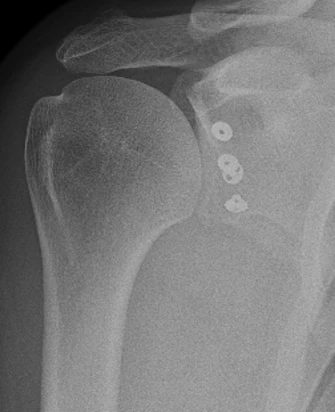
X-ray after keyhole bone block surgery. The graft is held with small buttons rather than screws.
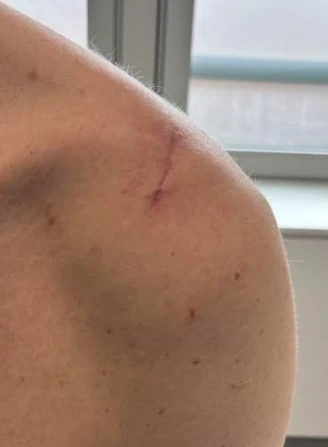
Scar 4 months after surgery, front of the shoulder.
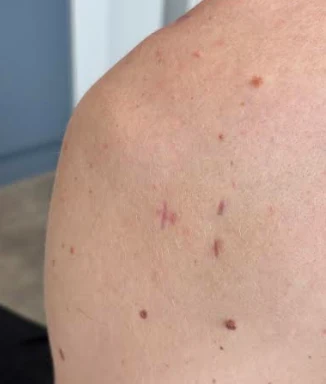
Keyhole scars 4 months after surgery, back of the shoulder.
02Who it may suit
03Compared with the usual operation
Bone block operations are usually done as open surgery with screws. This does the same job through keyhole incisions.
Using buttons instead of screws avoids screw-related problems, such as screws irritating or damaging the joint.
04The evidence
05Risks
06Typical recovery
Published papers you can read in full or in summary on PubMed.
Baring et al, J Shoulder Elbow Surg 2026
Results of keyhole bone block stabilisation in 41 patients, at an average of 3 years.
Boileau, Baring and Greco, 2021
Describes the keyhole bone block technique using buttons.
It can. No stabilisation operation removes the risk completely. In the series Mr Baring co-authored, 1 of 41 patients had instability again at an average of 3 years. After the open bone block operation, about 3 in 100 dislocated again over a mean of 16 years.
It depends on your shoulder. In published studies, the shoulder dislocates again less often after a bone block operation than after a labrum repair, particularly for people with bone loss or high-risk sport. Mr Baring will talk through which suits you at your assessment.
The piece taken from the end of the collarbone is not needed for normal shoulder function, and it can be taken from the same shoulder through one small incision on top.
As a guide: desk work at 2 to 4 weeks, driving at 6 to 8 weeks, manual work and non-contact sport from 3 months, and contact sport from 6 months, often sooner. Total recovery takes 3 to 6 months.
A failed previous stabilisation is one of the situations where a keyhole bone block may be considered.
An assessment is a chance to understand what is wrong and talk through every option, including not having an operation. Booking an assessment does not commit you to surgery.
Recognised by Aviva, AXA Health, Aetna, Bupa, Cigna Healthcare, Vitality, WPA, Simplyhealth, Allianz Care and Healix to treat their members. Please check your cover with your insurer before booking.
Initial consultation £350
Follow-up £250
Where you can be seen
One Welbeck
1 Welbeck Street, London W1G 0AR
King Edward VII's Hospital
Beaumont Street, London W1G 6AA
St John & St Elizabeth Hospital
60 Grove End Road, London NW8 9NH