Most AC joint injuries, often called a separated shoulder, heal without surgery. A London shoulder surgeon explains the grades, what recovery looks like and when an operation is worth considering.


If you have landed on the point of your shoulder, perhaps coming off a bike or in a tackle, and now have pain and a bump on top of the shoulder, you have probably injured the AC joint. It is often called a separated shoulder, and sometimes a dislocated collarbone.
Most AC joint injuries heal without an operation. That includes many where the end of the collarbone sits visibly higher than before. Surgery is considered for the more severe grades, and for some people whose shoulder is still painful or weak after a fair period of rehabilitation.
This guide explains what the AC joint is, how the injuries are graded, what recovery without surgery looks like, and when an operation is worth considering.
The acromioclavicular (AC) joint is the small joint at the top of the shoulder where the outer end of the collarbone (clavicle) meets a ledge of the shoulder blade called the acromion. You can usually feel it as a slight bump about a hand's width out from your neck.
Two sets of ligaments hold the joint together. The AC ligaments wrap the joint itself. The coracoclavicular ligaments run from the underside of the collarbone down to a hook of bone on the shoulder blade, and they do most of the work of holding the collarbone down.
A fall onto the point of the shoulder drives the shoulder blade downwards while the collarbone stays where it is. Depending on the force, the ligaments are sprained, torn, or torn completely with the collarbone pushed out of position. That difference is what the grades describe.
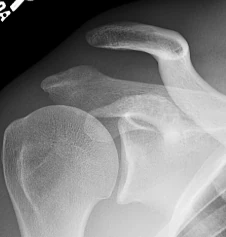
AC joint injuries are graded from I to VI, using what is known as the Rockwood classification. The grade comes from examination and an X-ray, sometimes taken with both shoulders in view for comparison.
| Grade | What has happened | What you might notice | Usual treatment |
|---|---|---|---|
| I | AC ligaments sprained, joint in position | Tenderness on top of the shoulder, no bump | Without surgery |
| II | AC ligaments torn, other ligaments sprained, joint slightly out of line | Small step at the end of the collarbone | Without surgery |
| III | Both sets of ligaments torn, collarbone end sits higher | A clear bump on top of the shoulder | Usually without surgery, surgery discussed in some cases |
| IV | Collarbone pushed backwards | Pain, bump may be less obvious | Surgery usually discussed |
| V | Collarbone sits much higher, with muscle attachments torn | A large, obvious bump | Surgery usually discussed |
| VI | Collarbone pushed downwards (very rare) | Severe pain after a high-energy injury | Surgery |
Grade III injuries are sometimes split into IIIA, where the shoulder stays stable and works well, and IIIB, where the shoulder blade is unstable and the shoulder does not work as well. That distinction often matters more for treatment than the size of the bump.
For grades I and II, and most grade III injuries, treatment is about settling the pain and then restoring movement and strength.
The bump on top of the shoulder in a grade III injury usually stays. It is a change in appearance, and for most people it does not affect how the shoulder works. Some people notice a click or an ache when they lie on that side, or with heavy overhead work, for some months.
People are often surprised that an injury which looks this obvious is so often left alone. The research is clear on why.
A review of 10 trials of grade III injuries found no difference between surgery and treatment without surgery in pain, strength, function or arthritis afterwards (Tang et al, Medicine 2018). In a Canadian multicentre trial of complete AC joint dislocations, people treated without surgery had better function scores at six weeks and three months than those treated with a hook plate. By one and two years the two groups were the same, and the people treated without surgery needed fewer further operations (Canadian Orthopaedic Trauma Society, Journal of Orthopaedic Trauma 2015). A 2026 review covering grades III to V reached the same conclusion: similar results at a year or more, with earlier recovery favouring treatment without surgery (Lameire et al, Orthopaedic Journal of Sports Medicine 2026).
Surgery does put the collarbone back in line on the X-ray. What these studies show is that, for many people, a straighter X-ray does not translate into a better shoulder, and the operation adds its own recovery and risks. That is why the decision rests on how the shoulder works and what you need from it, not on how it looks.
If you would like to know which grade you have and what that means for you, an assessment with Mr Baring will give you a clear answer. It is an assessment, not a commitment to surgery. You can book an appointment here.
Surgery is worth discussing when:
Timing matters for the type of operation. Within the first few weeks the torn ligaments can still heal if the joint is held in position. Later on, a reconstruction that uses a tendon graft to replace the ligaments may be needed instead. There is more on that operation on our AC joint reconstruction page.
There are two common ways to hold the joint in position while the ligaments heal after an injury.
A hook plate is a metal plate screwed to the top of the collarbone, with a hook that sits under the acromion to hold the collarbone down. It goes in through an open incision along the collarbone. Because the hook sits under the acromion and limits shoulder movement, the plate usually has to be removed in a second operation once the ligaments have healed, often around two to three months later.
A tightrope is two small metal buttons joined by strong suture. One button sits on top of the collarbone and the other under the hook of bone below it, and the suture holds the collarbone down in its normal position while the ligaments heal. Mr Baring puts it in through one incision of about 3cm and two small holes, using keyhole techniques. It stays in for life and does not usually need to be removed.
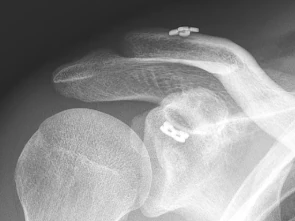
A 2025 review of 12 studies (683 patients) comparing the two found mixed results. People with a hook plate scored better on one shoulder function score and lost less blood during surgery. People with a tightrope had less pain and the collarbone sat closer to its normal position. Operating time and complications were similar (Lim et al, JSES Reviews, Reports and Techniques 2025). So neither is clearly better on every measure. The clear practical difference is that a hook plate usually means a second operation to take it out, and a tightrope does not. Our accelerated recovery page explains this in more detail.
No operation on the AC joint is risk-free. The risks include:
Mr Baring will go through the risks that apply to your shoulder before you decide anything.
Your plan will be tailored by Mr Baring and your physiotherapist. As a general guide:
In my experience: Mr Toby Baring
A cyclist comes to see you with an obvious bump on top of the shoulder. What do you tell them?
The first thing I do is reassure them that a visible bump is not the same as a bad result. Most AC joint injuries, including many that look dramatic, settle well without an operation, and the bump is mostly a cosmetic change. What I want to know is the grade, whether the shoulder blade is moving normally, and what they need the shoulder to do. For the higher grades, or for someone whose shoulder is still weak and painful months later, I will talk about surgery. When I do operate on a recent injury, I use a tightrope through small incisions, partly because it means one operation rather than two.
If you have injured your AC joint and want to know the grade and the right treatment, an assessment will give you that. For most people it ends with a rehabilitation plan. For the higher grades, or where rehabilitation has not worked, Mr Baring will explain the surgical options and their risks.
Mr Baring sees patients in London, usually within days, and can review your X-rays from A&E or arrange new ones. There is more about this work on the trauma and fracture management and sports injuries pages. Mr Baring is recognised by Aetna, Allianz Care, Aviva, AXA Health, Bupa, Cigna, Healix, Simply Healthcare, Vitality and WPA to treat their members. Please check your cover with your insurer before booking. Self-paying patients are welcome.
Book an appointment or call 07561 812 682.
Is a separated shoulder the same as a dislocated shoulder? No. A separated shoulder is an injury to the AC joint at the top of the shoulder, between the collarbone and the shoulder blade. A dislocated shoulder is when the ball of the upper arm comes out of the main shoulder socket. They are different injuries with different treatments.
How long does an AC joint injury take to heal? It depends on the grade. Milder sprains often settle within a few weeks. More severe injuries treated without surgery take longer, often a few months, before the shoulder feels strong for sport or heavy work.
Will the bump on my shoulder go away? In grade III and higher injuries the bump usually stays unless the joint is repaired. For most people it is a cosmetic change and does not affect how the shoulder works.
Do I need surgery for a grade 3 AC joint injury? Most people do not. Trials have found similar results with and without surgery at one to two years, with earlier recovery without it. Surgery is considered if the shoulder is still painful, weak or unstable after rehabilitation, or for some people with high overhead demands.
Can I cycle or play rugby after an AC joint injury? Yes, once the pain has settled and strength has returned. Cycling usually comes back before contact sport. Return should be based on comfort and strength, and after surgery on your surgeon's advice.
Will the tightrope need to be taken out? Usually not. The tightrope is designed to stay in for life. A hook plate, by contrast, usually needs a second operation to remove it once the ligaments have healed.
Mr Toby Baring is a consultant orthopaedic surgeon specialising in shoulder and elbow surgery, with a particular interest in arthroscopic rotator cuff repair, shoulder instability surgery and shoulder replacement. Read more about Mr Baring or book an appointment.