After a first shoulder dislocation, many people never have another. A London shoulder surgeon explains who is most at risk of it happening again, what the research shows and when surgery is worth discussing.

Your shoulder may well never dislocate again. Many people have one dislocation, recover with a short period of rest and some rehabilitation, and go on to use the shoulder normally for the rest of their lives.
The risk is not the same for everyone, though. It depends mostly on your age, your sex, what activities you do and whether the first dislocation damaged the bone. Young men who play contact sport are the group most likely to have it happen again. People over 40 are much less likely to.
This guide explains what the research shows about that risk, what you can do to reduce it, and when it is worth talking about surgery after a first dislocation rather than waiting to see what happens.
The shoulder is a ball sitting on a shallow socket, closer to a golf ball on a tee than a ball in a cup. A rim of cartilage called the labrum deepens the socket a little, and the ligaments and muscles around the joint hold the ball in place.
Most dislocations are forwards (anterior). As the ball comes out, it usually tears the labrum and the ligaments off the front of the socket. Surgeons call this a Bankart lesion. The back of the ball can also dent itself against the edge of the socket, which is a Hill-Sachs lesion. In some dislocations a small piece of bone breaks off the socket rim as well.
Once the shoulder has been put back, the question is whether those torn structures heal in a position that holds the ball securely again. In some people they do. In others they heal loose, or not at all, and the shoulder comes out more easily the next time. Our guide to anterior vs posterior shoulder dislocation explains the two directions, and shoulder dislocation: signs, causes and how to fix it covers what to do when it first happens.
The most useful guide to your own risk comes from studies that followed large groups of people after a first dislocation.
Those are figures for groups, not predictions for one person. A 19-year-old rugby player and a 55-year-old who slipped on ice sit at opposite ends of the range, and both are included in the overall figure.
The same 2015 review identified the factors with the strongest evidence behind them (Olds et al 2015):
A break in the bony bump on the outside of the ball, called a greater tuberosity fracture, was linked with a lower chance of the shoulder dislocating again. Bone loss from the socket rim, by contrast, is one of the main reasons a shoulder keeps coming out, and it changes which operation makes sense if surgery is needed.
Sport and work matter as well. Collision sports such as rugby, and activities that put the arm overhead and backwards under load, can put the most pressure on a healing dislocation.
For most people, the first treatment is not an operation. It is a short period in a sling for comfort, then gradually getting the shoulder moving and strong again.
The UK ARTISAN trial recruited 482 people after a first dislocation at 40 UK hospitals, with an average age of 45. Half had a single session of advice and written material, with the option to refer themselves to physiotherapy. The other half had the same advice plus a programme of physiotherapy. At six months, shoulder function was no different between the two groups (Kearney et al, BMJ 2024).
That does not mean exercise does not matter. It means that good advice and a clear plan you follow for yourself work as well as regular appointments for many people, and that you can ask for physiotherapy if you are not progressing. The British Elbow and Shoulder Society now sets out rehabilitation in stages, from early protection through movement and strengthening to criteria-based return to sport, whether or not you have an operation (Wong et al, Shoulder and Elbow 2026).
In practice, the stages look like this:
If you would like a clear view of your own shoulder, including whether the scan shows damage that changes the plan, an assessment with Mr Baring will give you that. It is an assessment, not a commitment to surgery. You can book an appointment here.
After a first dislocation, the pain settles and the movement comes back within weeks. The shoulder feels normal in daily life. That is good news, but it is not proof that the torn labrum has healed back to the socket. In many younger people it has not, and the shoulder only shows it when it is tested at speed, in a tackle, a fall or a throw.
That is why the next dislocation often arrives months after the first, at a moment when the person has stopped thinking about it. It is also why returning to contact sport is better decided on tested strength and control, and sometimes on what a scan shows, than on how the shoulder feels walking around.
The reverse is also true. Plenty of people with a first dislocation, especially those over 40, never have another one. For them an operation would add risk without adding much benefit. The aim of an assessment is to work out which group you are likely to be in.
Surgery after a single dislocation is not the usual first step, but for some people it is worth discussing early rather than after the next one. Mr Baring will usually raise it when:
There is trial evidence behind this. In an Edinburgh trial of 88 adults under 35 after a first dislocation, those who had a keyhole repair of the torn labrum were about three-quarters less likely to dislocate again over two years than those who had a keyhole washout of the joint alone (Robinson et al, Journal of Bone and Joint Surgery 2008). An earlier Canadian trial in people under 30 found fewer redislocations after early surgery, with a smaller difference in day-to-day function (Kirkley et al, Arthroscopy 2005).
The most common stabilisation operation in the UK is a keyhole labrum (Bankart) repair, which stitches the torn labrum back onto the socket. It works well for many people, but it is not a permanent fix for everyone. A review of studies with at least 10 years of follow-up found that 31% of people had some instability again and 16% dislocated again (Murphy et al, Journal of Shoulder and Elbow Surgery 2019). In one UK study of 67 adolescent rugby and contact athletes, 51% had instability again within about three years of a keyhole labrum repair (Torrance et al, American Journal of Sports Medicine 2018).
Where bone has been lost from the socket, or the risk is high, a bone block operation rebuilds the front of the socket with a piece of bone instead. Mr Baring performs this through keyhole incisions, using a small piece of bone from the end of the collarbone held with small buttons rather than screws. In the series he co-authored, 1 of 41 patients (2.4%) had instability again at an average of three years. The authors describe these as short-term results (Kyriacou et al, Journal of Shoulder and Elbow Surgery 2026). Our lower recurrence rate page compares the operations in detail, and keyhole shoulder stabilisation explains each one.
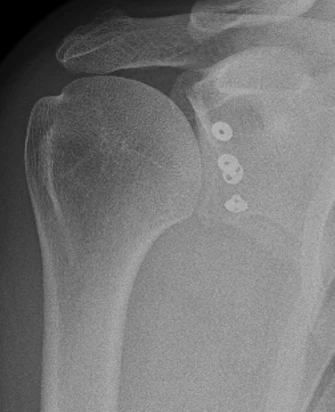
No stabilisation operation is risk-free. The risks include infection, stiffness, some permanent loss of outward rotation, nerve injury, the graft not healing after a bone block, and the shoulder becoming unstable again. Mr Baring will go through the risks that apply to your shoulder before you decide anything.
In my experience: Mr Toby Baring
What do you tell a young patient after their first dislocation?
I tell them two things. First, this does not automatically mean an operation, and many people never dislocate again. Second, how the shoulder feels at six weeks is not a reliable guide to whether it has healed. If you are in your late teens or twenties and want to go back to rugby, I would rather we look properly at the scan and talk about your risk now than wait for the next dislocation to make the decision for us. Sometimes that conversation ends with a rehabilitation plan and a clear target for return to sport. Sometimes it ends with surgery being worth considering. Either way, you leave knowing which group you are likely to be in and why.
If you are seeing a surgeon after a first dislocation, these are worth asking:
If your shoulder has dislocated once and you want to know your risk, or you are deciding whether to return to sport, an assessment will tell you what was damaged and what your options are. For most people the outcome is a rehabilitation plan. For some, the scan or the sport means surgery is worth discussing early.
Mr Baring sees patients in London, usually within days, and can arrange an MRI or CT scan where it would change the decision. There is more about this work on the sports injuries page and in our dislocated shoulder treatment and recovery guide. Mr Baring is recognised by Aetna, Allianz Care, Aviva, AXA Health, Bupa, Cigna, Healix, Simply Healthcare, Vitality and WPA to treat their members. Please check your cover with your insurer before booking. Self-paying patients are welcome.
Book an appointment or call 07561 812 682.
How likely is my shoulder to dislocate again after the first time? It depends mainly on your age and sex. A review of 1,324 people found that 39% had further instability after a first dislocation. In people aged 15 to 35 in one study, the figure was 56% within two years. People over 40 have a much lower risk.
How long does it take for a dislocated shoulder to heal? Pain usually settles and movement returns over a few weeks, and strength over a few months. Feeling normal is not the same as the torn tissue having healed, which is why return to contact sport is based on tested strength and control.
Should I have surgery after my first shoulder dislocation? Most people do not need it. It is worth discussing early if you are young and returning to contact sport, if the scan shows bone loss from the socket, or if the shoulder still feels unstable despite rehabilitation.
Do I need physiotherapy after a dislocated shoulder? A clear exercise plan matters. A large UK trial found that one session of advice, with the option to refer yourself to physiotherapy, gave the same function at six months as a full physiotherapy programme. If you are not progressing, ask for physiotherapy.
Can I play rugby again after a dislocated shoulder? Many people do. The decision should rest on tested strength and control, and on what the scan shows, rather than on time alone. Young contact athletes have the highest risk of it happening again, so it is worth an assessment before returning.
Will I get arthritis after a shoulder dislocation? Long-term studies show that wear in the joint becomes more common in the decades after a dislocation, particularly when the shoulder has come out repeatedly. It is one of the things weighed when deciding how to treat a shoulder that keeps dislocating.
Mr Toby Baring is a consultant orthopaedic surgeon specialising in shoulder and elbow surgery, with a particular interest in arthroscopic rotator cuff repair, shoulder instability surgery and shoulder replacement. Read more about Mr Baring or book an appointment.